A Trip to the Virginia Museum of History & Culture

A few weeks ago I took advantage of the nice weather and decided to stop by the Virginia Museum of History & Culture. Springtime is a perfect time to visit the various museums in the “Museum District” of Richmond, as is my right and privilege as someone who does not suffer from seasonal allergies.
Admission was $15, but as is the case with many high-profile museums in Richmond there are various discounts including free admission for those on EBT or SNAP benefits. As I am not yet a student, senior, or child I paid full price.
Note: I will not be discussing the exhibits in the order deliberately suggested by the museum, but rather the order that makes most sense for this format. As I do in most museums, I meandered based on vibes and backtracked to my heart’s content. Also, the museum's recommended path starts with watching a short film but I skipped it.
The Lost Cause Room
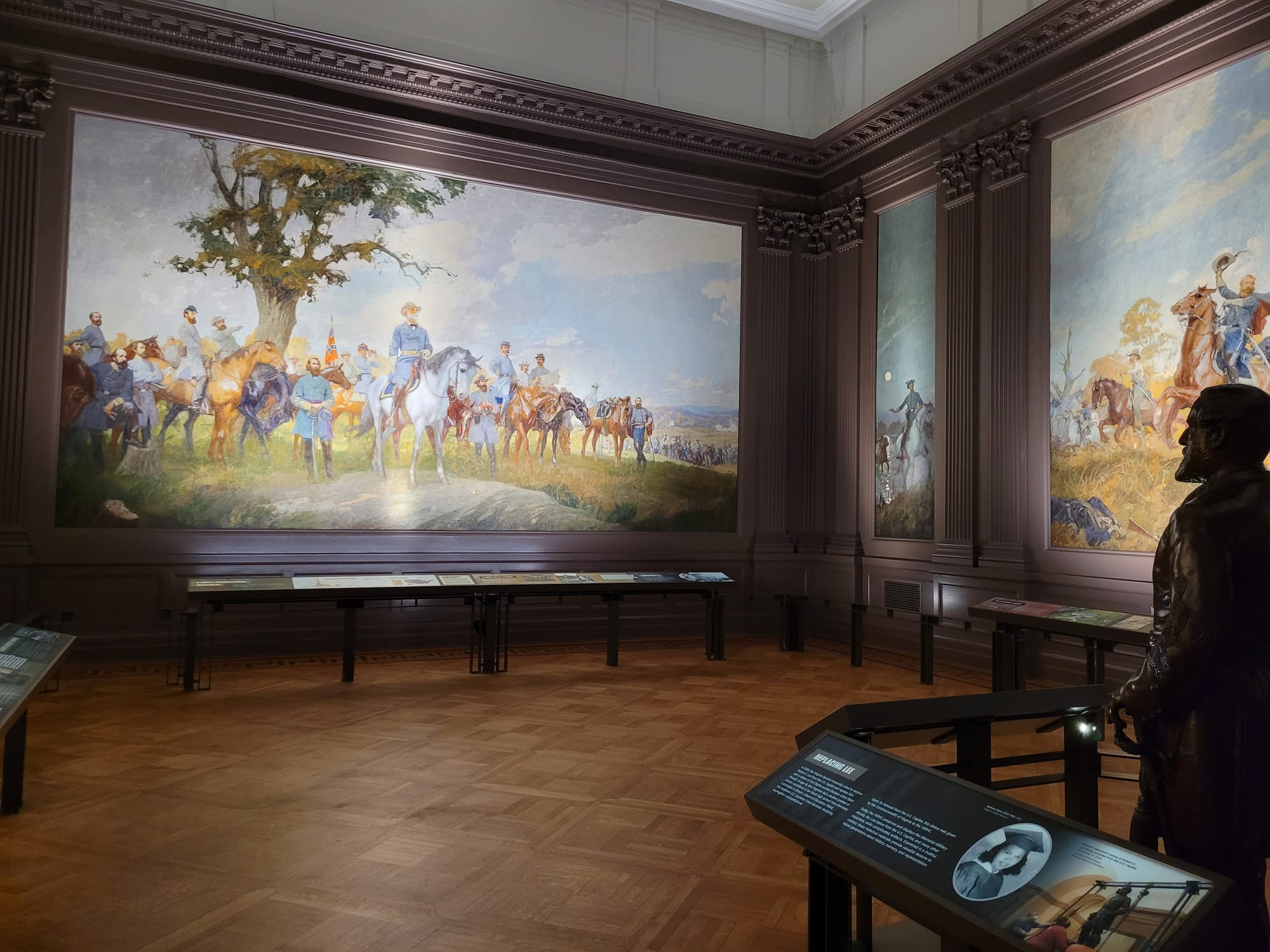
I named this one myself, but it is very apt. As you walk around the room, the plaques describe the timeline of Southern revisionism regarding the Civil War and how it relates to the architecture of the museum itself. The murals on the wall are “Four Seasons of the Confederacy”, a four-part piece of Lost Cause propaganda painted by a French artist between 1913 and 1920 with each season (starting with spring) depicting a romanticized picture of each stage of the war. It is a beautiful piece, and I’m glad it’s in a room that properly describes its role as a perpetuation of the Lost Cause.
The museum itself (the un-renovated part) was previously Battle Abbey, a building previously owned by the Confederate Memorial Association until it was purchased by the Virginia Historical Society in 1946. To my knowledge, the mural never needed to be moved and is merely re-contextualized in its current state.
The Main Room
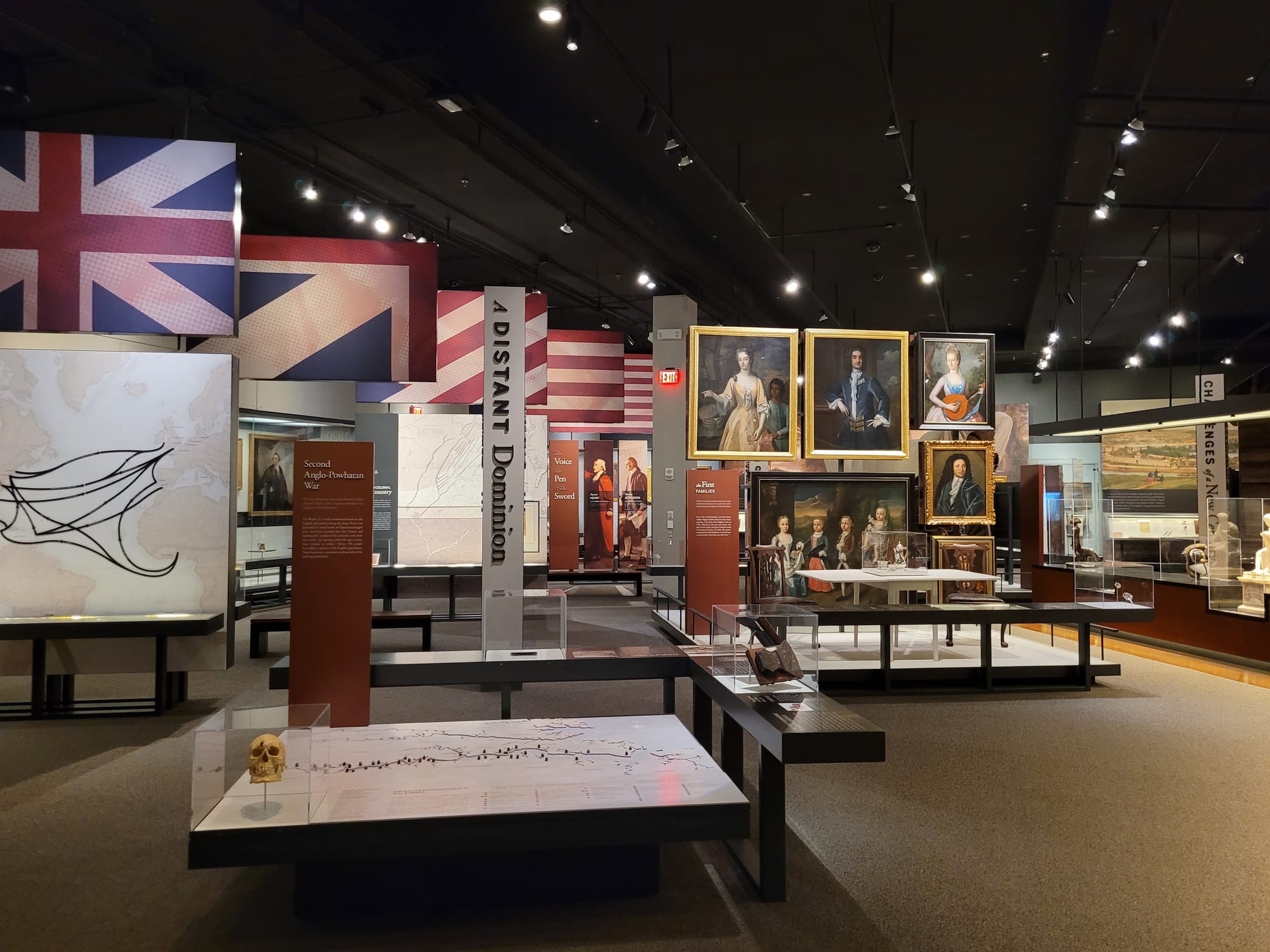
Titled “The Story of Virginia” by the curators, this is the main meat of the museum. It starts with a small vestibule with paleolithic and Native artifacts, many of which were off display with a sign explaining that the missing artifacts were being evaluated for compliance with the Native American Graves Protection and Repatriation Act. For those unaware (like I was before I researched it for this article), NAGPRA requires all museums that possess Native artifacts and receive federal funding to consult with the tribes from which the artifacts originated. Sometimes that means returning the artifacts to the tribes, sometimes the tribes allowing the museums to maintain the artifacts and keep them on display.
Past the vestibule is an enormous room that contains a concentrated timeline of events in Virginia’s history that wraps along the walls. The timeline includes the several failed colonization attempts before finally establishing a small, unsophisticated tobacco economy in the early-mid 1600s. A segment on the explorer John Smith’s hostile encounter and subsequent capture by the Powhatan tribe has an interesting Pro/Con section that presents arguments for and against the veracity of his account. Continuing along the edge of the room, Virginia grows into a full planter economy with its own gentry emulating its mother country. From this section comes a very funny label header: “George Washington starts a world war”. My own personal gripes about calling the 7 Years War a world war aside (I suppose Asia and Africa weren’t part of the world in 1756), I think it’s interesting that Washington firing the first shots is now part of the educational canon - that detail was left out in all my public school classes. Moving along, across the back wall of the room we see profiles of prominent Virginians of the early American republic ending with Zachary Taylor, the last nominally Virginian president. This section so far was excellent - the information was interesting, densely packed, and easy to follow.
The rest of the timeline is almost entirely the Civil War and Reconstruction. At this point we are in the middle of the back wall, and it is the expected Civil War paraphernalia. Muskets, uniforms, sabers, you know the drill. Near the end of the timeline they describe the lukewarm civil rights advancements under Jim Crow, completely skip over an egregious amount of time, and finish with a vestibule parallel to the Native section. They show the civil rights struggles of the mid 1900s such as the civil rights case Loving vs Virginia that legalized interracial marriage as well as highlighting the successful racial integration of schools. Past that, small celebrations of “First person of X demographic to Y” finish off The Story of Virginia.
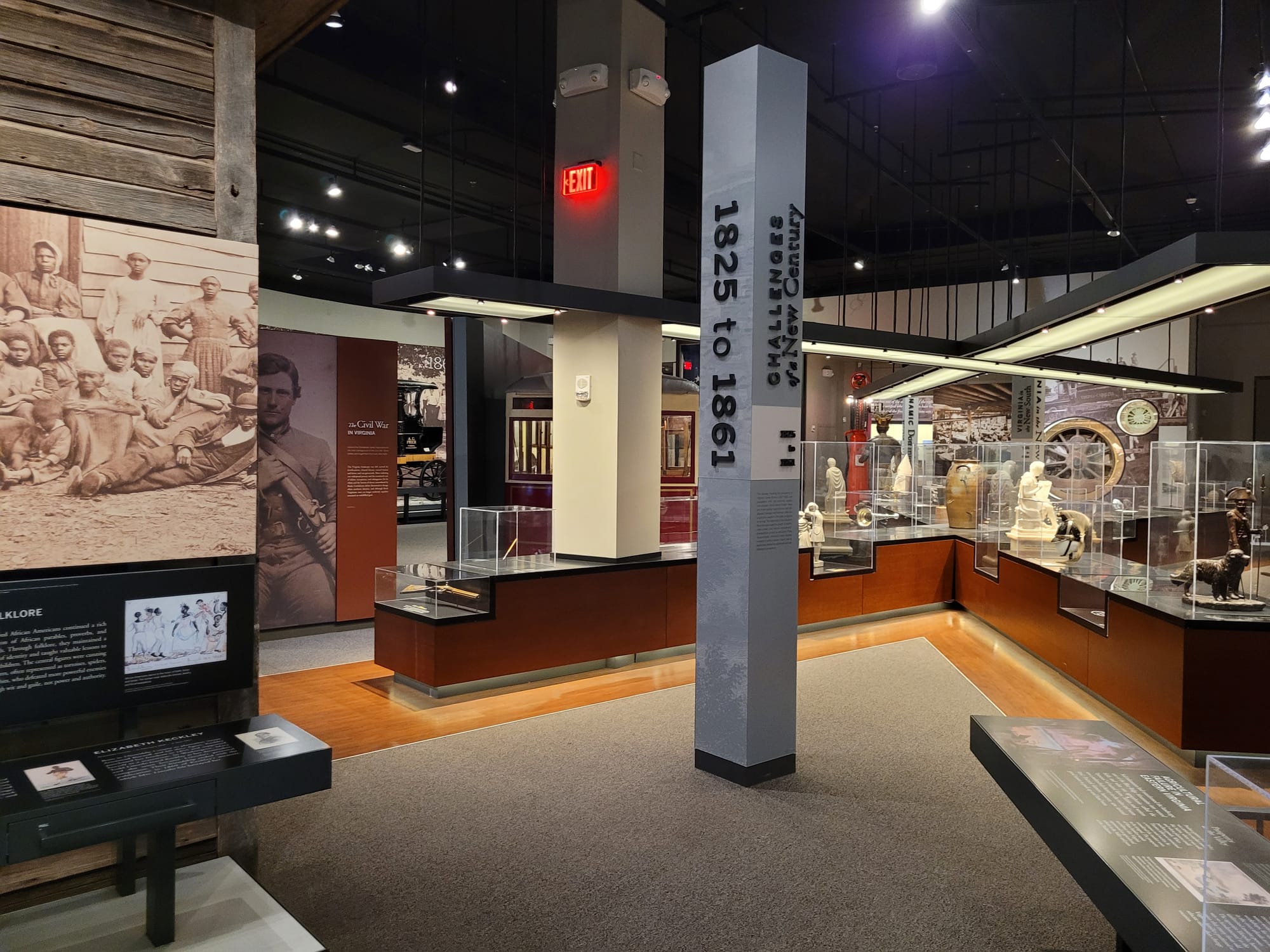
What I have described so far is simply hugging the wall all around the room without venturing into the inner room. The reason for this is because the exhibit is designed to have you dip into the interior but return to the wall to continue the narrative. This confused me at first, as I thought the artifacts on display in the interior were arranged in their own linear timeline, but I accidentally found myself somehow viewing them in reverse chronological order. Then again, I am prone to wandering and am easily confused - your mileage may vary.
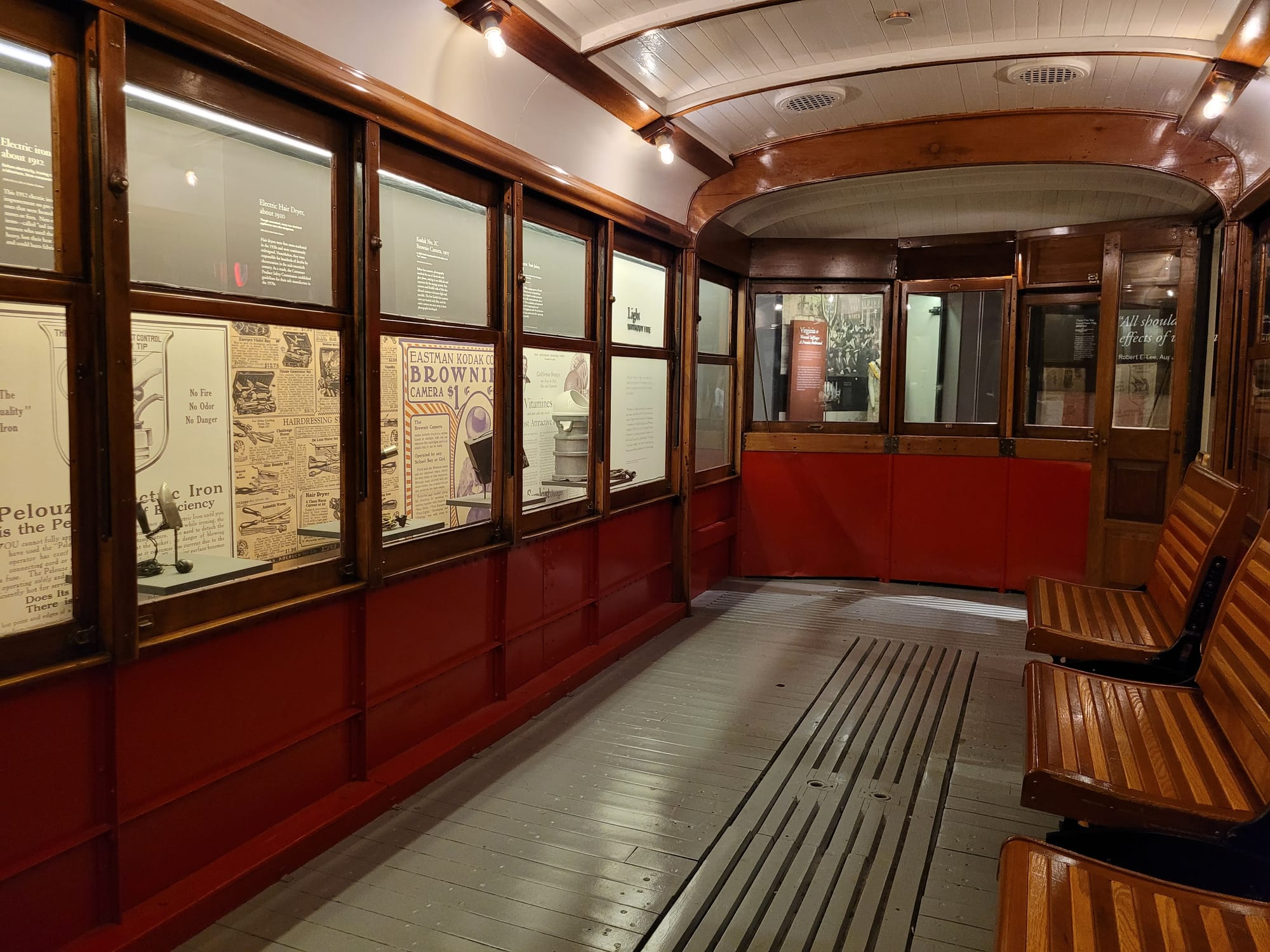
The weakest part of the room was a section of the interior that featured technological advancement in the turn of the 20th century. These are cool and all, but they were not invented by Virginians and don't have a direct connection to the state. As much as I love old streetcars and appreciate how important electric kettles are, it seems like the only reason they are displayed here is because Virginians (not to mention the entire country) used them a lot. This is adjacent to my largest complaint with this exhibit - after the Civil War, non-civil-rights accomplishments are noticeably absent or underwhelming. There is as much space dedicated to pre-1600 as there is post-1876.
The Art Gallery Nexus
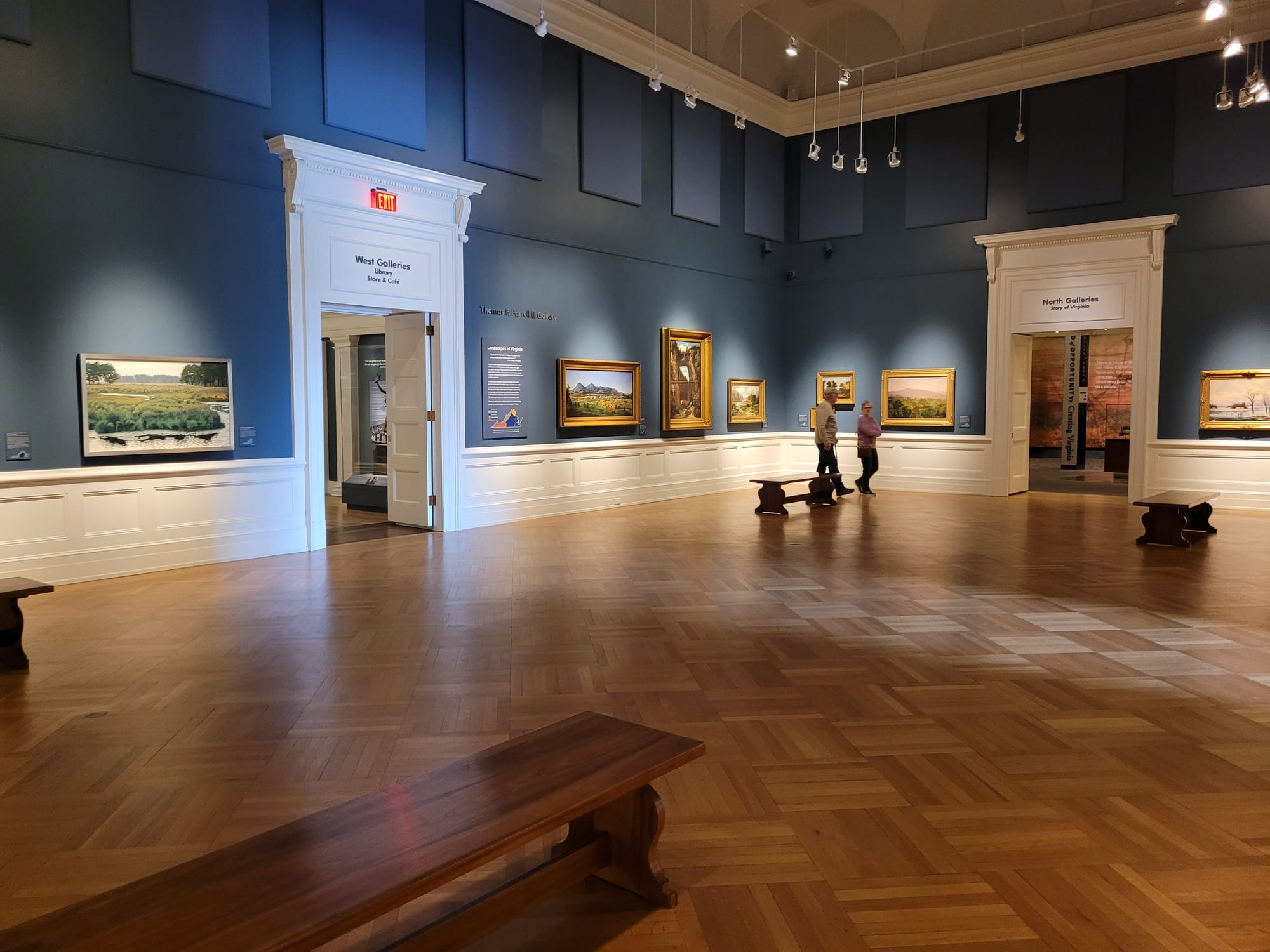
Connecting the 3 largest rooms of the museum is what I call The Liminal Art Gallery. As you would expect, featured on the walls are nature portraits of Virginian landscapes by various artists. If you have been to an art museum, this is a familiar format: open space, shiny brown flooring, and art on the walls. Its open and understated design serves as a welcome reprieve from the concentrated stimulation of the exhibits - I love it so much.
Virginia Mapped Out
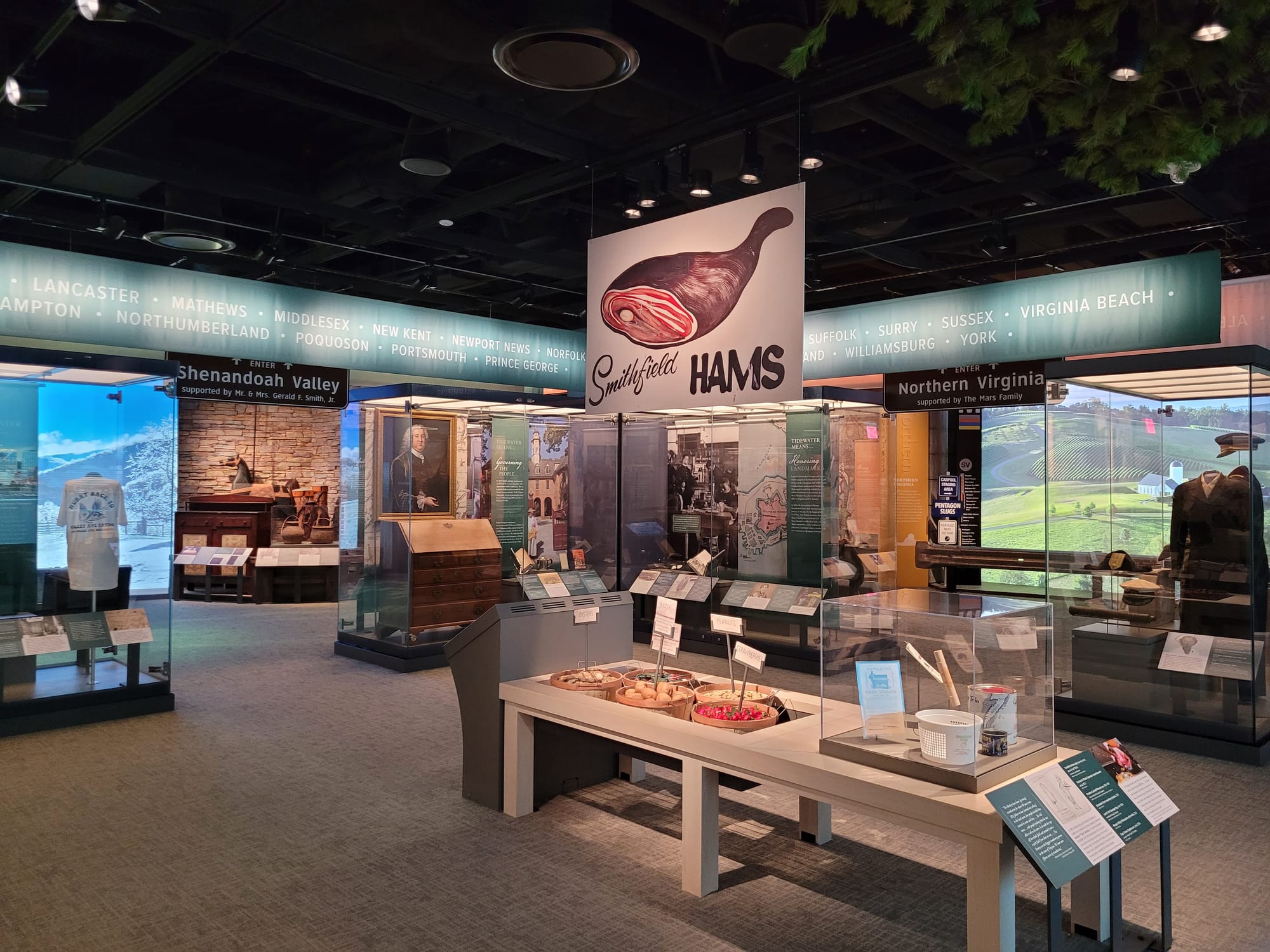
Called “Our Commonwealth” by the museum, this room is divided into smaller rooms each representing a geographical section of Virginia. Each section had a short history of the region as well as its place in modern Virginian life. It benefits from having walked through the main room first, as this room features more specific highlights and how it fits into the larger history of the state rather than describing the grander narrative. Virginia is one of the more ecologically diverse states, and it was nice to see that described in more detail than I expected.
I really enjoyed this area - conceptually it helped to highlight each area’s identity and I wish I had seen it when I first came to Virginia. Its coverage of the modern era for each area was my favorite part of the exhibit, primarily because it was a major piece missing from The Story of Virginia.
Temporary Exhibit - Immigrants of VA
I don’t have a lot to say about this one. This exhibit was a winding labyrinth of individual stories of immigrants coming to Virginia and facing adversity. Essentially all the stories can be boiled down to the same pattern: “X arrived in VA from Y country. It was not easy, but they became the first person of Y descent to Z.” Individual success stories are not particularly interesting to me, but I freely admit that I’m not the target audience. As a white guy born and raised in the US, I don’t have a personal attachment to those stories but understand their importance to those who need that encouragement.
As a slight digression: The entrance and exit of each major wing in the museum features a corporate sponsor - Altria (tobacco company), Dominon Energy (energy monopoly), TowneBank (bank for the towne) are the big ones I remember. For those unfamiliar with the Richmond area, Altria and Dominion are some of the largest companies in the region. Once I noticed this, I also started noticing that the exhibits retread ground often, restating information presented elsewhere, as if they did not consult with each other when designing the exhibits. I only started noticing this after, so maybe that is a narrative of my own invention. At least my extortionate energy bill is going towards a good cause, it seems.
Temporary Exhibit - Free Black Virginians
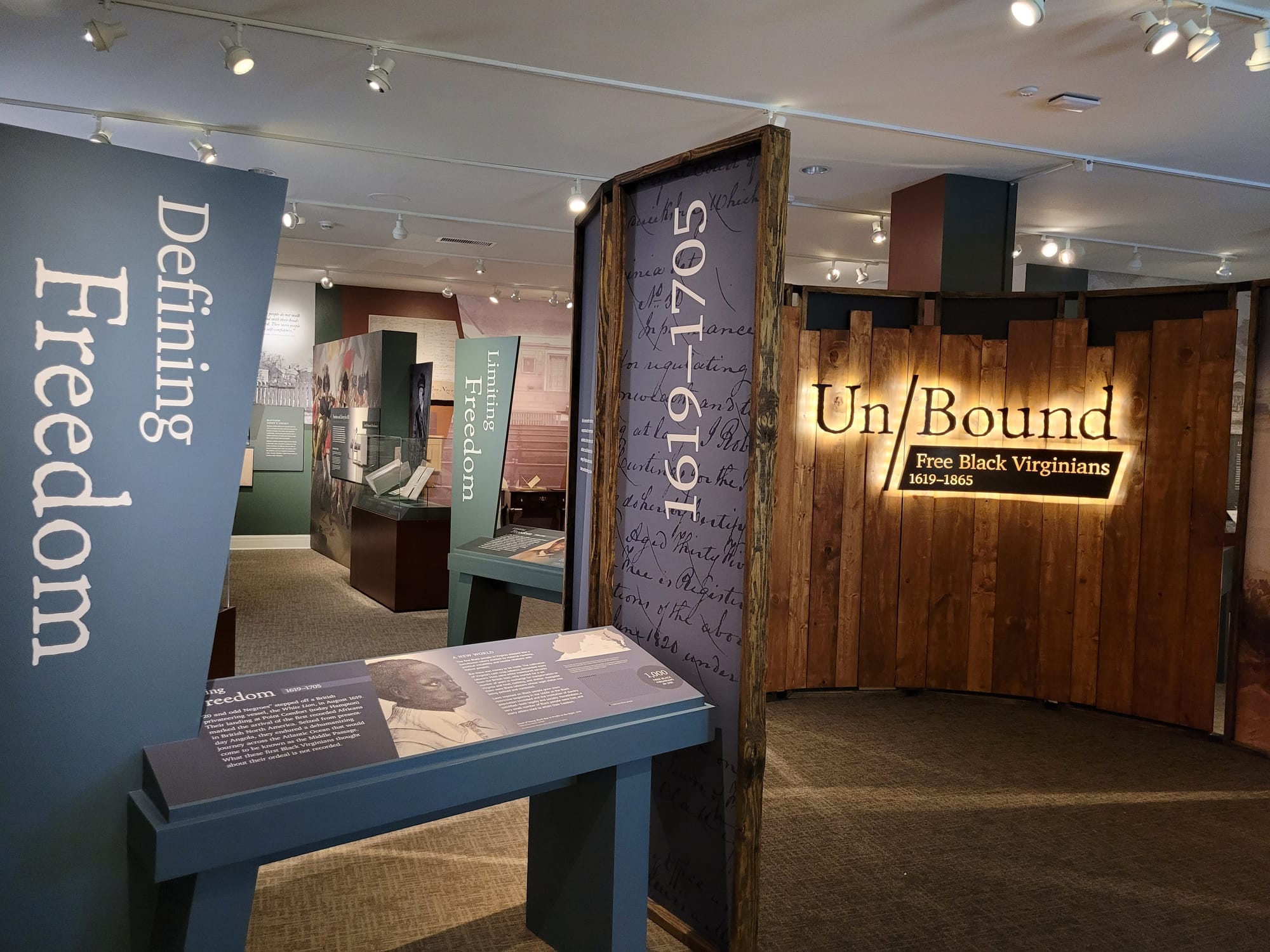
This is a smaller single-room “labyrinth-style” exhibit focused exclusively on the legal and social struggles of Blacks in Virginia. I “enjoyed” this room (I won’t pretend it was a fun 20 minutes). When discussing the South in the pre-emancipation United States, it’s easy to assume that every Black person was either enslaved or in some state of enslavement, but this was not the case. An especially interesting and heartbreaking story involved a free Black man who had a family with a free Black woman, but was later arrested for socializing with enslaved Blacks - a crime in Virginia at the time. Sources indicate that those he was socializing with were his own daughters working as servants. That story illustrated the complicated gray area between freedom and enslavement these folks lived under.
Thus far, I’ve left out how the museum handled slavery because it deserves its own section; under this exhibit is a good place to have that discussion. Virginian slavery is seemingly everywhere in the museum - every room has a reference to it in some form. When I first visited the museum in 2021, I was caught off guard by how often it was highlighted and had the general reaction of “yeah I get it, slavery was bad, let’s move on”, but in studying history my thoughts have evolved. Black Americans make up a significant portion of the population here in Virginia, and the effects of this institution were so central to the economic and social systems here it has earned its real estate. I bring this up only to say that if you visit this museum and it seems to be all about slavery, it’s because it really was that significant to Virginia’s history. After all, if half of the biggest room in the museum is dedicated to the Civil War, doesn’t it make sense to highlight the injustice that caused that war?
Closing thoughts
Seeing everything the museum had to offer took me roughly 2.5 hours, and was more than worth the price of admission. Its information density left me exhausted by the end, but a good museum should do that! If you are new to the region, this is a great museum to get a sense of what VA is about.
As always, thank you for reading!
No AI was used at any point in the creation of this blog